Car Sort: Color Puzzle Level 371 Solution Walkthrough
Route Reference
Key opening, middle, and finish positions for this route.
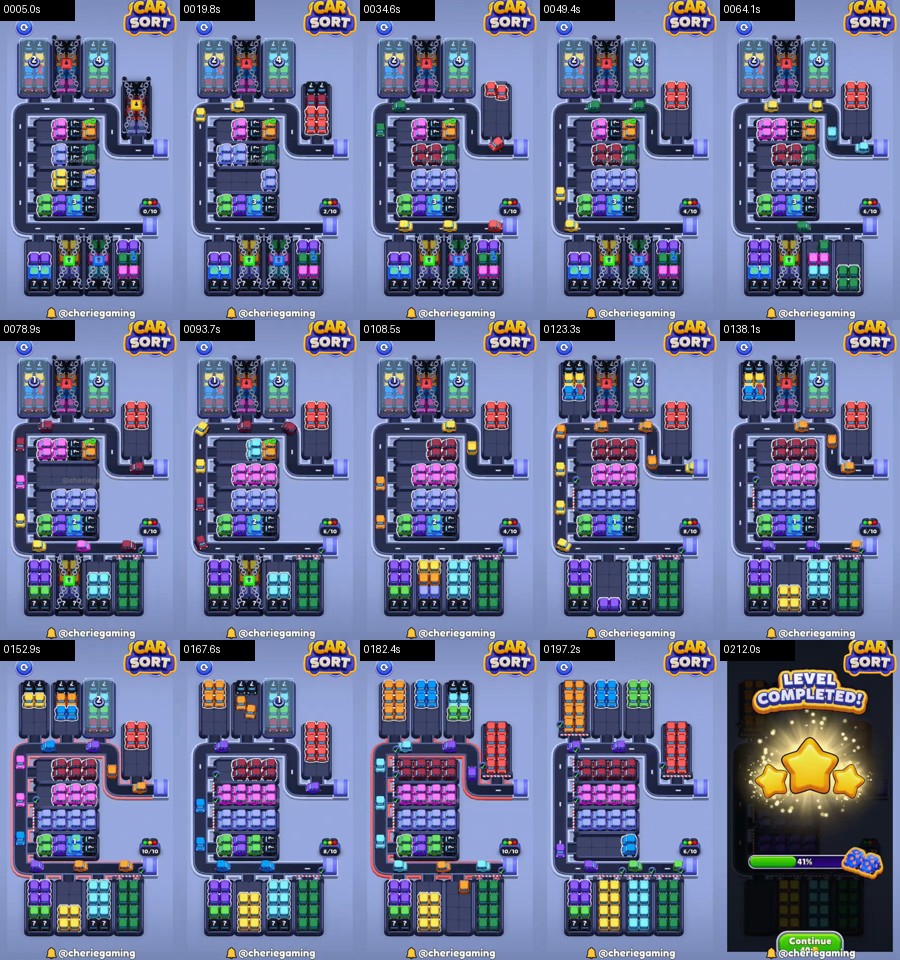
Read the crowded inner rectangle
The upper bank exposes red, green, cyan, purple, blue, and orange. Center shelves show pink, yellow, purple, red, blue, cyan, and several numbered cells. Bottom columns repeat green, orange, purple, yellow, cyan, red, and white. Although the board looks symmetric, one empty side road must be maintained.
Use this route reference:
upper red-green → cyan-purple → blue-orange → pink center → yellow-purple bands → red-blue center → cyan release → bottom green-orange → purple-yellow → cyan-red → white-pink cleanup
Finish each complete row before changing sides of the rectangle.
Open the upper edge
Clear red and green first. Cyan and purple follow, then blue and orange. Wait between pairs for the upper corners to empty.
The opening checkpoint is a dark crown and a complete pink center face. Do not start the lower green or orange columns, even though their road entrance is visible. They would occupy the lower corners needed by the center rows.
Peel the dense center
Pink is the first central release. Yellow and purple follow as broad horizontal bands. Red then clears the next shelf, followed by blue. Cyan is the final inner release and should move only after both side roads are empty.
Each removed band should leave a clean dark stripe. A mixed stripe indicates a missed car and must be completed before descending. The center becomes the only usable buffer for the lower bank.
Clear the lower bank in pairs
Green and orange go first, beginning at the open corner. Purple and yellow follow. Cyan and red form the next pair. White and pink are cleanup colors; clear the shorter exposed face first and save the taller final column for an empty frame.
After every pair, inspect both lower corners and the side used by the last group. A marker remaining there means the garage has not accepted the full batch.
Recovery in a dense board
A top-edge jam points to an upper tower. Side trouble beside the center identifies pink, yellow, purple, red, blue, or cyan. A lower-corner blockage belongs to the current bottom pair.
When two colors are active, complete the one with a fully visible remaining face. Do not add traffic from a repeated color elsewhere. The repeated group may belong to a deeper numbered shelf.
If a center panel stays closed, inspect the horizontal band directly above it. One local face is incomplete. Restart only if that face is hidden and both side roads are occupied.
Before completion, verify the upper and center zones are dark and the bottom holds one solid group. The final white, pink, or yellow batch should travel around the frame without pause.
Level 371 succeeds when density is converted into orderly horizontal space. Upper pairs clear the crown, center colors leave dark stripes, and those stripes provide room for the lower pairs to finish.
Correcting the route reference
The source images for Level 371 use video ID 7O0EJaXVKAA; both route references on this page must point to that matching asset. The board's visible checkpoints are a dark upper crown, a striped empty center, and a single-color lower cleanup column.
During the center phase, resist switching merely because another numbered face lights up. Pink must clear before the yellow-purple band, and red-blue must leave before cyan. Each pair frees the exact horizontal capacity required by the next.
At the final handoff, choose the bottom column closest to the currently empty corner. Clear it entirely and allow the marker to leave the side road. The far column can then take the full perimeter. This nearest-first finish avoids trapping one last car behind the lower garage mouths.
Keep the striped center truly empty
The dark horizontal stripes are the working space for every later group. After pink, yellow-purple, and red-blue, inspect each stripe from edge to edge. A colored cell at the far side may be the tail of a batch rather than part of the next layer. Complete it before cyan opens the lower route.
The upper orange group is small but controls one crown corner. If it remains while pink starts, the center car can meet orange at the upper side. Finish orange, wait for the corner, then begin the first inner row. This small pause separates crown traffic from center traffic.
Green and orange below form a positional pair. Take the one beside the open lower corner, finish it, and use the empty bay for the other. Purple-yellow and cyan-red repeat this method but should each be treated as new complete pairs, not mixed into one long lower wave.
If a bottom counter opens while blue is still leaving the center, ignore it. Blue travels along the side road farther than its face suggests. The lower group is ready only after the corresponding side edge becomes dark and the cyan release face is fully visible.
During recovery, identify whether the stranded marker is level with a stripe or a column. A stripe-level marker belongs to the center and must be repaired horizontally. A marker below the rectangle belongs to a lower column. This simple height check avoids choosing a repeated color from the wrong zone.
The cleanup state should show a solid block of dark center rows and one or two lower columns. Clear the nearer column, pause for the corner, and then take the last face. No car should re-enter from the crown after this point.
If the crown does release another face, leave it parked until the lower stream ends. That late tower is safe only when both side edges of the crowded rectangle are visibly clear.